27 October 2026
The Rathod brothers: one family, and the sound of the nineties
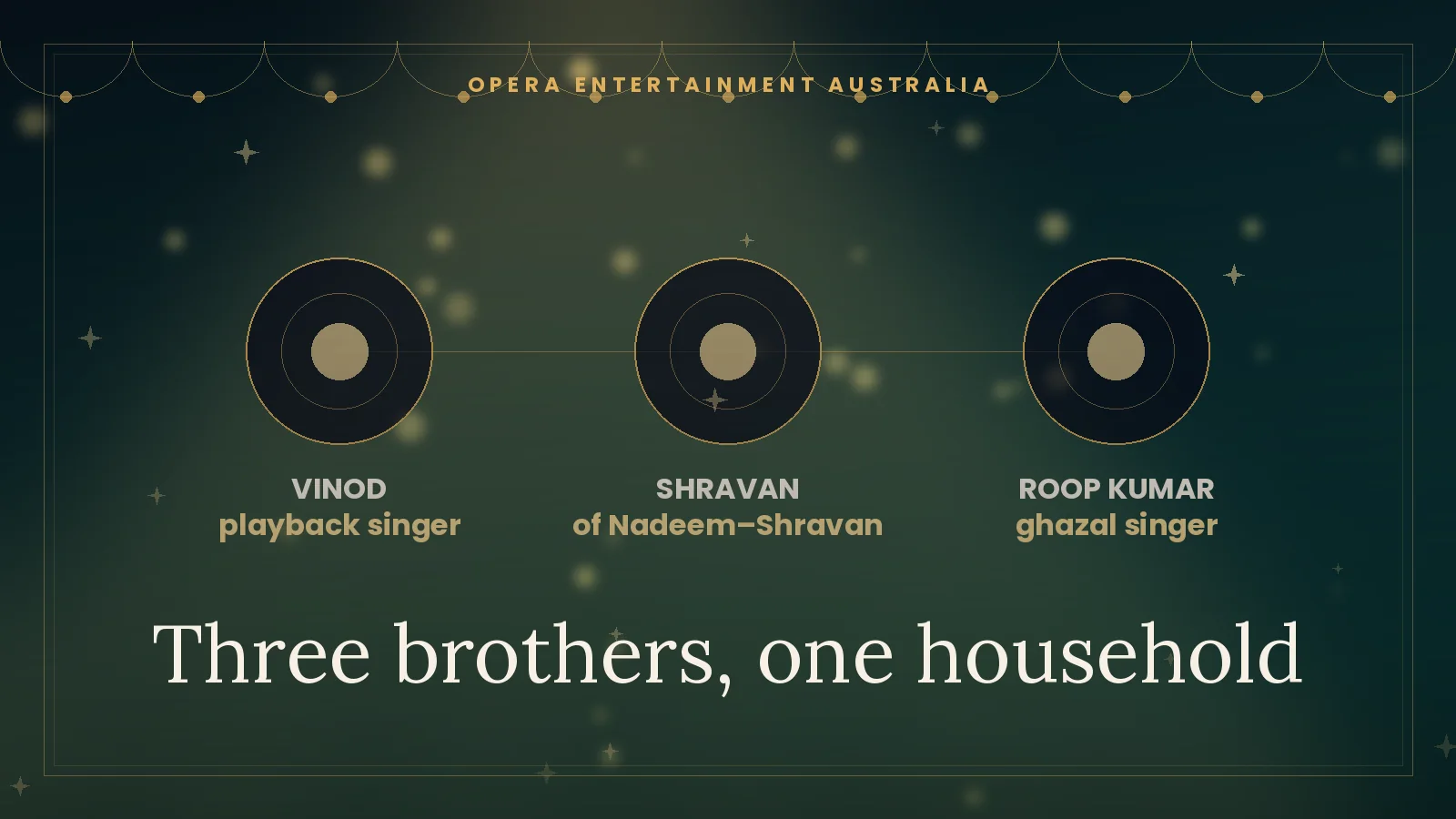
Three brothers from one Mumbai household: a playback singer, half of Nadeem–Shravan, and one of India's finest ghazal voices.
Here is a fact that is easy to read past. A sizeable share of the Hindi film music that an entire generation grew up on came out of one household in Mumbai.
The father
Pandit Chaturbhuj Rathod was a classical vocalist of the Aditya Gharana of Jamnagar and an exponent of dhrupad — the oldest surviving form of Hindustani classical vocal music, and the most austere. He was also a teacher, whose students included the composers Kalyanji–Anandji and the ghazal singer Manhar Udhas.
His three sons grew up inside that. Not as a hobby or an after-school activity, but as the ordinary weather of the house.
Shravan, who wrote the decade
Shravan Rathod became half of Nadeem–Shravan, with Nadeem Saifi — one of the most commercially successful composing partnerships Hindi cinema has produced. If you were anywhere near a radio in the 1990s you know their work, whether or not you know their names.
Shravan died in April 2021, of COVID-19. Nadeem–Shravan songs are a substantial part of Vinod's own catalogue, which gives that material a particular weight when he sings it now. Some of those songs are a brother's work.
Roop Kumar, who took the other road
The youngest brother, Roop Kumar Rathod, became one of India's most respected ghazal and playback singers. Like Vinod, he began on tabla, trained by their father, and was accompanying ghazal singers through the 1980s before he sang professionally himself.
His breakthrough came with “Sandese Aate Hai” from Border in 1997, and he went on to record “Tujh Mein Rab Dikhta Hai” and a long body of ghazal work. Where Vinod became the industry's most adaptable voice, Roop Kumar became its most restrained one — the same training producing two very different instruments.
What the training actually gave them
Both brothers started as percussionists before they sang. That detail explains more about Vinod's career than any amount of discussion about vocal range.
A tabla player does not hear a song as a melody floating above a rhythm. They hear where every syllable lands against the beat — a fraction ahead of it, a fraction behind, or exactly on it. That is the skill a playback singer needs most and is almost never taught. A dance number for Govinda has to sit slightly ahead of the beat to pull you forward; a song for a heartbroken hero has to hang slightly behind. Same notes, same tempo, entirely different feeling.
The dhrupad training underneath did the other half: breath, and the ability to hold a long note dead steady. It is why Vinod could choose exactly where to let a phrase fray for a Baazigar song, which is far harder than singing it cleanly.
Why it matters in November
When Vinod Rathod sings the Nadeem–Shravan material on this tour, he is singing his brother's compositions. When he holds a long note without it moving, that is his father's teaching. When a comedy number lands exactly on time, that is the tabla.
A concert is usually described as one person on a stage. This one has a family standing behind it.
Vinod Rathod Australian Tour 2026 — four cities, dates and tickets