10 August 2026
One voice, three heroes: how Vinod Rathod sang for Sanjay Dutt, Shah Rukh Khan and Govinda
Khalnayak, Baazigar and a string of Govinda hits came from the same throat in the same eighteen months. Here is how that is possible — and why almost nobody else could do it.
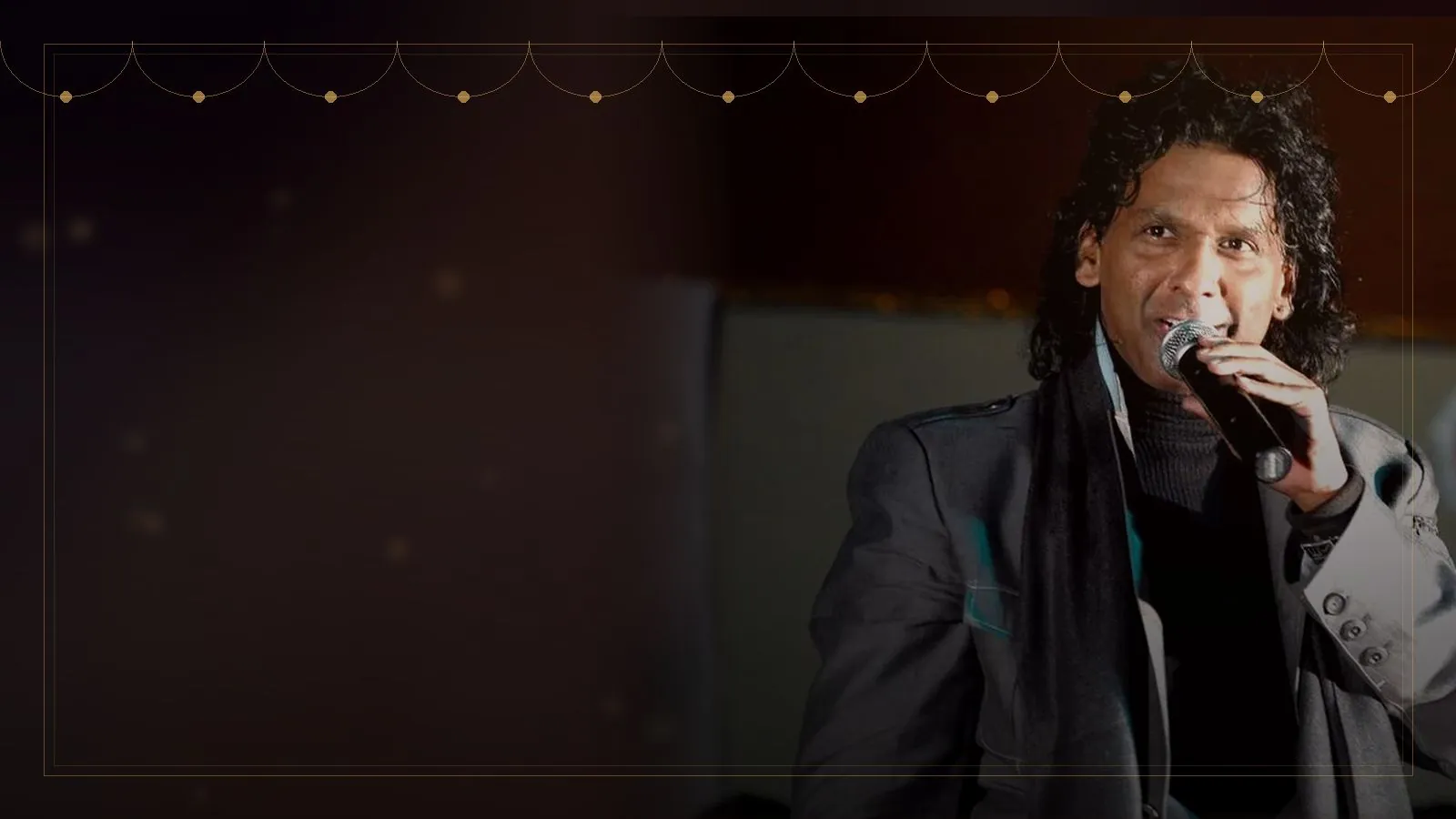
Play three songs back to back. “Nayak Nahi Khalnayak Hoon Main” from Khalnayak. “Ae Mere Humsafar” from Baazigar. “Main Hoon Number Ek Gawaiya” from Saajan Chale Sasural.
The first swaggers. The second aches. The third is pure comic bravado. They belong to three different actors — Sanjay Dutt, Shah Rukh Khan, Govinda — and to three completely different men on screen. They were all recorded by the same singer, within roughly eighteen months of each other.
How does one throat do that? The answer starts a generation before any of those films.
A house where music was the weather
Vinod Rathod was born in Mumbai on 12 September 1962, the second son of Pandit Chaturbhuj Rathod — a classical vocalist of the Aditya Gharana of Jamnagar and an exponent of dhrupad, the oldest surviving form of Hindustani classical vocal music.
That last detail matters more than it might appear. Dhrupad is the austere end of the classical tradition. There is very little ornamentation to hide behind. What it trains, above everything, is control of a single sustained note — breath, pitch and the shape of a tone held steady for a very long time. A singer who has done that work has a level of command over their instrument that most popular singers never need to develop.
Vinod’s father was not only a performer but a teacher, having trained figures including the composers Kalyanji–Anandji and the ghazal singer Manhar Udhas. His sons grew up inside that: Shravan, who became half of the composing duo Nadeem–Shravan, and Roop Kumar, who became one of India’s finest ghazal singers.
He started on the tabla, not the microphone
Here is the detail that most accounts skip past, and it is arguably the single most important thing about how Vinod Rathod sings: he began as a percussionist.
Both he and his brother Roop Kumar trained on tabla under their father before either of them sang professionally. Years of that work rewires how a musician hears a song. You stop hearing the melody floating above the rhythm and start hearing where every syllable lands against the beat — slightly ahead of it, slightly behind it, or exactly on top of it.
That is precisely the skill a playback singer needs and is rarely taught. A song for Govinda has to sit a fraction ahead of the beat, because that is what makes a dance number feel like it is pulling you forward. A song for a wounded Shah Rukh Khan has to hang fractionally behind, because that is what regret sounds like. Same notes, same tempo, entirely different feeling — and the difference is measured in milliseconds.
Singing a character, not a song
Playback singing in Hindi cinema is a stranger craft than it looks from outside. The singer is not performing as themselves. They are supplying the voice of a character, played by an actor, in a scene that in most cases has not been shot yet. They have to sound like somebody else’s face.
This is where Rathod separated himself. His voice was described throughout the nineties as unusually adaptable — able to shift to suit different actors, different characters and different emotional situations, which is exactly why composers kept calling.
Consider what the three assignments actually demanded.
For Sanjay Dutt: menace held back
“Nayak Nahi Khalnayak Hoon Main” is a villain announcing himself. It cannot be shouted — a shouting villain is a joke. It has to be delivered with weight underneath and complete control on top, the sound of a man who does not need to raise his voice to be frightening. That is a dhrupad singer’s territory: power held in reserve rather than spent. It earned him a Filmfare nomination.
For Shah Rukh Khan: the crack in the voice
Baazigar gave him two of the film’s biggest songs, “Ae Mere Humsafar” and “Chhupana Bhi Nahi Aata”, and the brief was the opposite. Shah Rukh Khan in 1993 was young, wounded and dangerous in a way that read as vulnerability. The vocal had to sound slightly unguarded — a little air in the tone, phrases that give way at the end rather than landing squarely.
It is far harder to sing imperfectly on purpose than to sing perfectly. Only a singer with complete technical control can decide exactly where to let go.
For Govinda: comic timing, sung
And then “Main Hoon Number Ek Gawaiya”, which is a joke with a tune attached. Govinda’s comedy lived in his timing, and a vocal that lagged even slightly would have killed it. This is the tabla player’s song: every syllable pushed marginally forward, riding the beat rather than sitting on it.
The proof came later, when he stopped singing
If the claim that Rathod was really a voice actor needs evidence, the strongest piece arrived in the 2000s — when he began dubbing.
He provided Hindi speaking voices for South Indian actors in dubbed films, including Nagarjuna, Mahesh Babu and Jr NTR. Not singing. Acting, in spoken dialogue, as somebody else.
Very few playback singers have made that crossing, and it is not a coincidence that this one did. The skill he had been using since 1986 was never purely vocal. It was the ability to work out who a character is and then become audible as them.
Hear it in a room
None of this is fully audible through a phone speaker. What a live performance exposes is the technique underneath — the sustained notes with no studio to help them, the placement against a live band rather than a click track, the shift in colour when he moves from a villain’s song to a lover’s song within the same set.
Vinod Rathod tours Australia for the first time in November 2026 — Brisbane on the 13th, Sydney on the 14th, Melbourne on the 15th and Adelaide on the 22nd, with a live band in every city.
Vinod Rathod Australian Tour 2026 — all four cities, dates and tickets